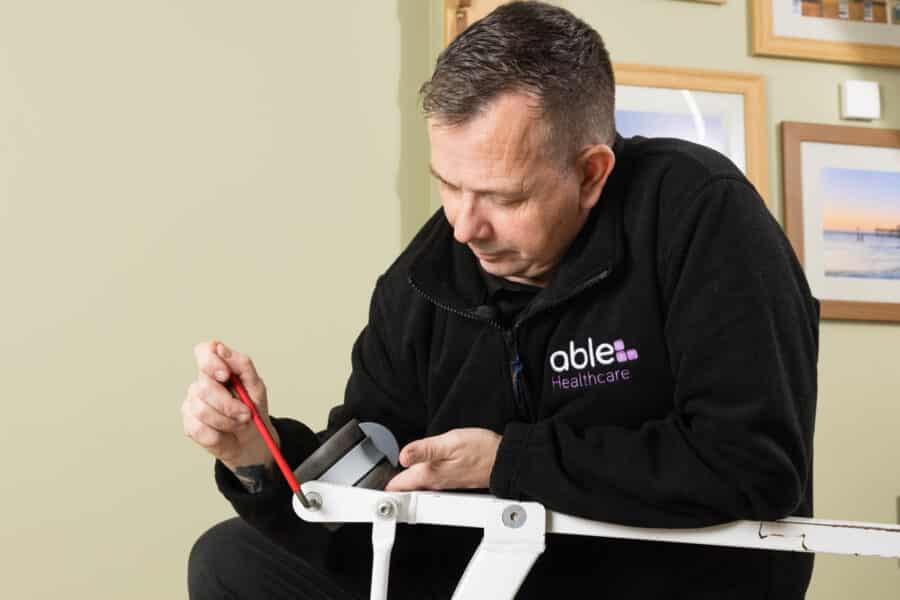


Care homes rely on equipment every day to move, position, support and care for residents safely. Hoists, slings, profiling beds, specialist baths, wheelchairs and other equipment can all deteriorate through normal use, which makes planned servicing and maintenance an important part of equipment management.
Effective care home equipment servicing is about more than waiting for something to break. It should combine planned maintenance, staff checks, timely repairs, accurate records and, where applicable, statutory inspections such as LOLER thorough examinations.
This guide explains how those different responsibilities fit together, how often equipment should be checked and some of the common maintenance mistakes care homes should avoid.
If you are unsure what equipment needs servicing, inspection or LOLER examination, Able can review your current equipment and servicing schedule with you.
What Is Care Home Equipment Servicing?
Care home equipment servicing is planned maintenance carried out to help keep equipment safe, reliable and in good working order.
Depending on the equipment and manufacturer’s instructions, a service may include:
- Visual inspection for wear, damage or deterioration
- Mechanical and electrical checks
- Testing controls, brakes, actuators and safety features
- Checking batteries and charging systems
- Lubrication or adjustment where required
- Checking fixings, fasteners and moving components
- Identifying parts that are worn or approaching replacement
- Functional testing after maintenance
- Recording findings, repairs and recommendations
The exact service should reflect the type of equipment, how heavily it is used and the manufacturer’s maintenance instructions.
What Care Home Equipment Needs Servicing?
A care home’s maintenance programme should consider all work equipment where deterioration could affect safety or reliability.
Typical care equipment may include:
- Mobile patient hoists and stand aids
- Ceiling track hoists
- Hoist slings and lifting accessories
- Profiling and specialist beds
- Specialist baths, bath hoists and bath lifters
- Shower chairs and shower trolleys
- Wheelchairs and mobility equipment
- Changing tables and examination couches
- Riser and recliner chairs
- Pressure care mattress systems and pumps
- Patient weighing scales
- Other specialist care equipment
Different equipment may need different types and frequencies of maintenance, inspection or examination. A six-monthly LOLER schedule for a patient hoist, for example, should not automatically be applied to every item of equipment in the building.
Servicing, Inspection and LOLER: What Is the Difference?
One of the most common equipment-management mistakes is treating every type of check as though it is the same thing.
Routine and Pre-Use Checks
Staff may need to carry out simple checks before equipment is used. These can identify obvious damage, missing components, unusual operation or other reasons why the equipment should not be used.
For lifting equipment, HSE specifically recognises the importance of appropriate pre-use and routine checks in addition to formal examination.
Servicing and Preventive Maintenance
Servicing aims to maintain the equipment in safe working condition and address deterioration before it leads to failure.
Under PUWER, work equipment provided for use at work must be maintained in an efficient state, in efficient working order and in good repair.
PUWER Inspection
PUWER may also require inspection where equipment safety depends on installation conditions or where deterioration could lead to dangerous situations.
The appropriate inspection frequency depends on risk, the equipment and its operating conditions rather than one universal timetable.
LOLER Thorough Examination
A LOLER thorough examination is a separate, systematic examination carried out by a competent person on lifting equipment covered by the regulations.
It is not simply another name for a routine service.
Where equipment is used to lift people, LOLER normally requires thorough examination at least every six months. Lifting accessories such as slings are also normally examined every six months. Alternatively, examinations can follow a written examination scheme drawn up by a competent person.
Our guide to LOLER vs PUWER in care homes explains the distinction in more detail.
How Often Should Care Home Equipment Be Serviced?
There is no single service interval that applies to every piece of care-home equipment.
The maintenance schedule should take account of:
- The manufacturer’s servicing instructions
- How frequently the equipment is used
- The environment in which it operates
- The equipment’s age and condition
- Previous faults or repair history
- Safety-critical components
- Any applicable statutory inspection or examination requirements
Some equipment may have an annual planned service, while heavily used or safety-critical equipment may require more frequent attention.
LOLER intervals should be managed separately. Where lifting equipment is used to lift people, or an item is a lifting accessory, the usual statutory thorough-examination interval is six months unless an appropriate written examination scheme specifies otherwise.
See our care home LOLER regulations guide for more on which lifting equipment is covered.
Why Planned Equipment Servicing Matters
Resident and Staff Safety
Deterioration is not always obvious during everyday use. Worn castors, damaged cables, tired batteries, loose fixings, deteriorating slings and failing actuators can all become more serious if they are not identified and addressed.
Planned maintenance provides an opportunity to find developing faults before equipment fails during use.
Reducing Unexpected Breakdowns
Equipment failure can remove an important hoist, bed, bath or wheelchair from service at short notice.
Preventive servicing cannot eliminate every breakdown, but it can reduce avoidable failures by identifying deterioration before components fail completely.
Extending Useful Equipment Life
Replacing worn parts, making adjustments and dealing with minor faults promptly can help equipment remain serviceable for longer.
It also gives managers better information when deciding whether further repair remains economical or replacement would be more sensible.
Creating a Reliable Maintenance Record
Good service records show what has been checked, which faults have been identified and what work has been completed.
This history becomes particularly useful when the same equipment develops repeated faults or reaches the later stages of its working life.
Common Care Home Equipment Maintenance Pitfalls
The strongest maintenance programme is not simply one with regular engineer visits. Day-to-day equipment management between those visits matters as well.
Skipping Planned Maintenance Because Equipment Still Works
Equipment does not need to have stopped working before it needs attention.
Components can deteriorate gradually while the equipment still appears functional. Waiting for complete failure often turns a manageable maintenance issue into an urgent repair.
Confusing a Service With a LOLER Thorough Examination
Servicing and LOLER serve different purposes.
A hoist may be serviced regularly and still require its statutory LOLER thorough examination. Equally, passing a LOLER examination does not remove the need to maintain the equipment in accordance with PUWER and the manufacturer’s requirements.
HSE guidance confirms that routine maintenance and statutory thorough examination should be treated as separate responsibilities.
Ignoring the Manufacturer’s Instructions
The manufacturer’s instructions should form an important part of the maintenance programme.
They may specify:
- Maintenance intervals
- Replacement schedules for particular components
- Approved parts
- Cleaning methods
- Lubrication requirements
- Battery care
- Inspection points
- Equipment service life
Using generic maintenance rules instead of the instructions for the actual equipment can mean important checks are missed.
Delaying Repairs
A minor fault can become more expensive or more dangerous if equipment continues to be used without assessment.
Staff should have a clear process for reporting faults and removing equipment from service where its continued use may be unsafe.
If a LOLER thorough examination identifies a defect that presents an immediate danger, HSE guidance requires effective action so that the equipment is not used until the defect has been remedied.
Poor Asset Records
Without an accurate equipment register, it becomes much harder to know:
- What equipment is on site
- Where each asset is located
- When it was last serviced
- When the next service is due
- When a LOLER examination is due
- What previous faults or repairs have occurred
- Whether the equipment is approaching the end of its recommended service life
Asset identification is particularly important for slings and lifting accessories because staff need to be able to match records to the individual item.
Using the Wrong Cleaning Method
Care equipment needs to be cleaned, but the wrong chemical or process can damage some components.
Cleaning products should be compatible with the equipment manufacturer’s instructions, particularly around upholstery, electrical controls, sling fabrics, seals and specialist coatings.
Overlooking Calibration Where It Is Required
Calibration is not relevant to every piece of care equipment, but it can be important for devices such as patient weighing scales or equipment that relies on an accurate measurement.
Where calibration is required, it should form part of the appropriate maintenance and quality-control schedule.
Failing to Train Staff in Everyday Checks
An engineer may only see a piece of equipment periodically. Care staff see it every day.
Relevant staff should know how to recognise obvious problems and what to do when they find one.
That can include checking for:
- Visible damage or unusual wear
- Damaged sling fabric, stitching or attachment points
- Loose or missing components
- Unusual noises or movement
- Battery or charging problems
- Fault messages
- Damaged castors or brakes
- Controls that do not respond correctly
Patient Hoists and Slings: The 2026 MHRA Safety Alert
Patient hoists and slings deserve particular attention.
In September 2026, the MHRA issued a National Patient Safety Alert covering all types of patient hoists and slings following incidents involving death and serious harm from falls.
The alert highlights several areas that care providers should review, including:
- Effective pre-use checks for hoists and slings
- Hoist and sling compatibility
- Staff training and competence
- Maintenance and servicing
- LOLER examination
- Equipment service-life information
- Accurate equipment inventories and maintenance records
It also calls for a documented equipment-management system that records information such as the manufacturer, model, location, last service, service-life information and LOLER examination dates.
For slings specifically, see our LOLER sling inspection guide.
Pre-Use Checks Between Engineer Visits
Planned servicing does not replace everyday checks by the people using the equipment.
Staff should follow the manufacturer’s instructions and the home’s own procedures before using equipment.
For hoists and slings, the 2026 MHRA alert particularly emphasises standardised pre-use checks and a pause-and-check step after the initial load is taken up but before the person is fully lifted, so attachment points can be confirmed as secure.
If something does not look, sound or operate as expected, staff should know how to report the problem and prevent unsafe use until the equipment has been assessed.
Keeping Care Home Equipment Maintenance Records
A good equipment record should make it easy to see the history and current status of an asset.
Depending on the equipment, useful information can include:
- Asset or identification number
- Manufacturer, model and serial number
- Location
- Date placed into service
- Manufacturer maintenance requirements
- Previous servicing and repairs
- Date of last service
- Next planned service
- LOLER examination dates where applicable
- Reported defects and corrective work
- Recommended replacement or service-life information
Records should be updated when equipment moves between rooms or sites so that items do not disappear from the servicing schedule.
What Happens If Equipment Fails a Check or Inspection?
The action needed depends on the fault and how much risk it presents.
If equipment appears unsafe during a pre-use check, staff should follow the home’s reporting procedure and avoid using it until an appropriate person has assessed the problem.
During a LOLER thorough examination, the competent person records defects and determines their significance. Some defects require the equipment to be taken out of service immediately, while others may need corrective work within a stated timescale.
Putting a clear process in place for identify → isolate → report → repair → confirm safe return to use prevents faulty equipment simply finding its way back into circulation.
Choosing an Equipment Servicing Provider
When comparing servicing providers, price is only one consideration.
It is worth asking:
- Which types and brands of care equipment can you maintain?
- What does the service actually include?
- How are defects and recommendations recorded?
- Can you supply and fit replacement parts?
- How quickly can you respond to breakdowns?
- Can you maintain an asset register and servicing schedule?
- Can you provide LOLER thorough examinations where required?
- How do you maintain appropriate independence between maintenance and the statutory thorough examination?
- What happens when equipment is found unsafe?
The final point is important. HSE confirms that the same organisation can provide servicing and LOLER examinations, but the competent person carrying out the thorough examination should be sufficiently independent and impartial and should not simply be assessing their own maintenance work.
Preparing for Your Next LOLER Examination
For relevant lifting equipment, managers should know what assets are due for examination and make sure the equipment can be identified and accessed when the competent person attends.
Before the visit, check that:
- Your equipment register is current
- Hoists and slings can be uniquely identified
- Previous examination records are available
- Known faults have been reported
- Equipment has not been moved to another area without records being updated
- Relevant manufacturer information is available where needed
Our LOLER inspection checklist for care homes provides a fuller preparation guide.
Care Home Equipment Servicing from Able
Able supports care homes with planned equipment servicing, repairs, LOLER thorough examinations and PUWER-related equipment checks across a wide range of care equipment.
Our engineers work with equipment including hoists, slings, profiling beds, specialist baths, wheelchairs, shower equipment, pressure-care systems and other specialist care equipment.
We also help with the administration around the equipment. Many of our customers use our asset tagging and equipment-management service so individual items can be identified, their history can be tracked and upcoming visits can be planned before examinations become overdue.
Where equipment develops a fault, our team can also support with parts, repairs and breakdown visits rather than leaving servicing and repair as two disconnected processes.
Build a Better Equipment Maintenance Plan
A strong care-home maintenance programme combines several layers:
- Staff pre-use checks
- Prompt fault reporting
- Planned preventive servicing
- Manufacturer-recommended maintenance
- PUWER inspections where required
- LOLER thorough examinations where applicable
- Accurate asset and service records
- Timely repairs and replacement planning
Managing those elements together makes it easier to keep equipment available, understand its condition and take action before small problems become larger ones.
If you would like help reviewing your equipment register, servicing schedule or LOLER requirements, speak to our equipment team.
Care Home Equipment Servicing FAQs
How often should care home equipment be serviced?
There is no single servicing interval for every type of care equipment. The schedule should consider the manufacturer's instructions, frequency of use, environment, age, condition, repair history and any relevant inspection or examination requirements.
Is equipment servicing the same as a LOLER thorough examination?
No. Servicing is maintenance intended to keep equipment in safe working condition. A LOLER thorough examination is a separate statutory examination of relevant lifting equipment carried out by a competent person.
How often do patient hoists need a LOLER thorough examination?
Lifting equipment used to lift people is normally thoroughly examined at least every six months. Lifting accessories such as slings are also normally examined every six months. A competent person's written examination scheme can specify a different interval.
What care home equipment should be included in a maintenance plan?
The maintenance plan should consider equipment such as patient hoists, slings, profiling beds, specialist baths, wheelchairs, shower equipment, pressure-care systems, patient scales and other work equipment where deterioration could affect safety or reliability.
What equipment servicing records should a care home keep?
Useful records include the asset number, manufacturer, model, serial number, location, previous servicing and repairs, last and next service dates, LOLER examination dates where applicable, reported defects and relevant service-life information.
What should staff do if care equipment appears damaged or unsafe?
Staff should follow the home's fault-reporting procedure and avoid using equipment that may be unsafe until it has been appropriately assessed. Equipment with a dangerous defect should not return to use until the problem has been remedied.
Can the same company service equipment and carry out LOLER examinations?
Yes, but the competent person carrying out the LOLER thorough examination should be sufficiently independent and impartial. HSE guidance says they should not simply be assessing their own maintenance work.