

What Is the True Cost Per Wash in a Care Home?
Understanding your cost per wash is one of the most accurate ways to measure laundry efficiency in a care home. Rather than focusing only on the price of detergent, cost per wash reflects the total expense of running each cycle — including labour, energy, water, textile wear, maintenance, and chemical usage.
Many care homes underestimate their laundry spend because they track product invoices rather than operational cost. Without calculating cost per wash properly, hidden inefficiencies can inflate overall laundry budgets without being obvious.
In a regulated care environment, inefficient laundry processes can also affect hygiene standards, infection control performance, and inspection outcomes.
How to Calculate Cost Per Wash in a Care Home
To understand your true laundry costs, you need to calculate the full expense of each wash cycle — not just the detergent used.
Include the following elements:
-
Labour cost per cycle
-
Energy usage (kWh × electricity tariff)
-
Water consumption per wash
-
Chemical dosing cost
-
Textile replacement allowance
-
Equipment servicing and maintenance allocation
Simple Formula
Total monthly laundry cost ÷ Total number of washes = Cost per wash
Example
If your total monthly laundry spend is £1,600 and you complete 800 washes:
£1,600 ÷ 800 = £2.00 per wash
In many UK care homes, cost per wash typically ranges between £1.80 and £2.50, depending on staffing structure, machine efficiency, chemical accuracy, and rewash rates.
Without calculating this properly, providers often focus on detergent price alone, creating an incomplete and sometimes misleading view of total operational cost.
What Makes Up the Average Cost Per Wash?
Detergent usually represents only a small percentage of total laundry expenditure. The majority of costs sit elsewhere in the process.
A typical cost breakdown in care homes looks like this:
-
Labour (40–50%) – Staff time for sorting, loading, unloading, folding, storage, and management
-
Textile replacement (15–25%) – Wear, shrinkage, staining, and damage
-
Energy (10–15%) – Electricity and gas consumption per cycle
-
Indirect costs (10–15%) – Equipment depreciation, repairs, and overhead allocation
-
Detergent and chemicals (3–7%) – Wash chemistry and dosing
While chemicals may represent a small percentage of total spend, incorrect dosing or poor product performance can increase energy usage, rewashes, textile damage, and staff time — all of which significantly raise the true cost per wash.
This is why detergent price alone is rarely the most accurate measure of value.
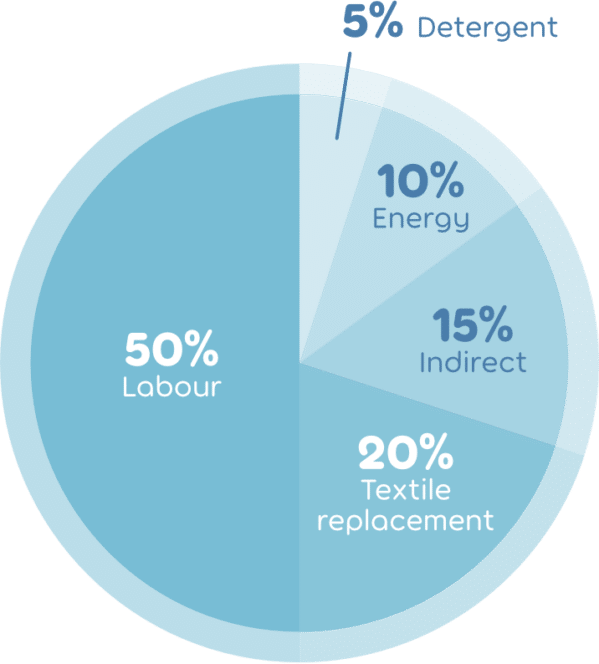
The average care home’s laundry cost breakdown
Why Cost Per Wash Matters Beyond Budget
Cost per wash is not just a financial metric. In care homes, laundry performance directly affects hygiene standards and infection prevention.
Inconsistent dosing or underperforming chemistry can result in:
-
Increased rewashes
-
Persistent odours
-
Poor stain removal
-
Textile degradation
-
Higher labour demand
Over time, these issues raise operating costs and can contribute to wider compliance concerns. Measuring cost per wash properly allows care homes to balance budget control with hygiene performance.
How Auto-Dosing Systems Influence Cost Per Wash
One of the most effective ways to control cost per wash is through consistent and accurate chemical dosing.
Manual dosing can lead to:
-
Overuse of detergent
-
Inconsistent wash results
-
Increased rewash rates
-
Chemical waste
Auto-dosing systems regulate the precise amount of product used per cycle, adjusting for:
-
Soil level
-
Fabric type
-
Water conditions
-
Temperature
-
Load size
By improving consistency, care homes can reduce chemical waste, limit rewashing, and protect textiles — all of which contribute to lowering the overall cost per wash.
Unsure What Your Current Cost Per Wash Really Is?
Many care homes assume their laundry system is efficient until a full cost-per-wash breakdown tells a different story.
If you’d like an independent review of your current setup — including chemical dosing, rewash rates, and machine efficiency — we can assess it and provide a clear cost comparison.
The Role of Wash Chemistry in Cost Control
The effectiveness of wash chemistry directly influences operational efficiency.
High-quality, concentrated detergents may have a higher upfront cost per container, but they often:
-
Require lower dosage volumes
-
Improve stain removal performance
-
Reduce rewashes
-
Extend textile lifespan
Some care homes also include laundry emulsifier for care homes alongside detergent to break down greasy residues such as body creams and food oils, helping improve stain removal and reduce costly rewashes.
Lower-grade or diluted products may appear cheaper but can increase usage per cycle, driving up the true cost per wash.
Evaluating chemicals based on performance per cycle — rather than price per drum — provides a more accurate cost comparison.
Real-World Example: Identifying Hidden Laundry Costs
In one care home review, a provider was using low-cost laundry products but continued to experience persistent staining and odour issues. At the same time, water, energy, and rewash rates were increasing.
Further assessment showed that the detergent was diluted, requiring more than double the intended volume per cycle to achieve acceptable results. This significantly increased chemical use, staff time, and utility costs — raising the true cost per wash beyond expectations.
By correcting dosing accuracy and improving chemical performance, overall wash quality improved while operational costs stabilised.
Key Takeaways
-
Cost per wash reflects the full operational expense of each laundry cycle — not just detergent price.
-
Labour and textile replacement usually represent the largest cost components.
-
Inconsistent dosing and poor chemistry increase rewashes and energy consumption.
-
Most UK care homes operate between £1.80 and £2.50 per wash.
-
Measuring cost per wash accurately allows providers to balance hygiene performance with financial control.
Understanding this metric gives care homes a clearer view of laundry efficiency and highlights opportunities for improvement.
Ready to Reduce Your Laundry Cost Per Wash?
If you’re unsure whether your current system is delivering the best performance for its cost, a structured review can quickly highlight opportunities to improve efficiency and reduce hidden waste.
We work with care homes to optimise dosing accuracy, chemical performance, and wash processes — helping lower cost per wash while maintaining hygiene standards.
Laundry Cost per Wash FAQ’s
Why isn’t detergent price the best measure of cost?
Because rewashes, energy, and water use often add more to the total bill.
How much of laundry costs come from detergent?
On average, detergent is only about 5% of total laundry expenses.
What hidden costs increase laundry bills in care homes?
Extra labour, textile replacement, energy use, and rewashing all add up.
How can auto-dosing systems lower cost per wash?
They deliver the right dose every time, reducing waste and inefficiency.
Can high-quality products really save money?
Yes—better detergents prevent rewashes and reduce energy use, cutting costs overall.
Has this approach worked for other care homes?
Yes—switching from cheap products to efficient systems often lowers costs and improves results.